Anthropic’s Claude Code Security has turned the vulnerability discovery process into an automated arms race, shifting the industry’s greatest challenge from detection to prioritization and disclosure.
The launch of Claude Code Security on February 20, 2026, sent a shockwave through the markets, erasing $15 billion in market cap from cybersecurity leaders. The reaction went beyond AppSec; cybersecurity stocks sold off hard that day: CrowdStrike (-8%), Cloudflare (-8.1%), Okta (-9.2%), and SailPoint (-9.4%), dragging sector ETFs to their lowest levels in months.
Investors briefly priced in a world where AI could compress parts of the vulnerability detection market. But while they reacted to the threat of AI "replacing" traditional scanners, they missed the more systemic shift: we are entering an era of radical transparency where detection is cheap, but justification is expensive. For software vendors, this isn't just about better security, it's about a looming operational crisis in how they communicate risk to their customers.
The looming disclosure paralysis
The first wave of this shift is driven by a simple mathematical reality: AI is producing code faster than humans can secure it, while simultaneously making it easier for everyone to find the flaws.
The Velocity Mismatch: Studies and industry testing show that a large fraction of AI-generated code contains security flaws, often mapping to OWASP Top 10 issues like XSS, SQL injection, and hard-coded secrets. Recent reports indicate a 40–45% vulnerability rate in AI-generated snippets across many models, with certain languages like Java failing secure-coding checks in more than 70% of samples.
The "Researcher in a Box": AI vulnerability agents can now scan large codebases and dependencies at low marginal cost. These tools find real issues and surface complex bugs that traditional tools missed, leading to a surge in CVEs being formalized—especially in open-source libraries—as maintainers receive machine-generated reports at scale.
As these tools move into the hands of every enterprise customer, the "security by obscurity" era is officially over. Customers no longer wait for a vendor's disclosure; they scan the software themselves and demand immediate answers for every finding.
The communication gap: solving the "justification debt"
The real pain point emerging is not the vulnerability itself, but the "Justification Debt." When a customer scans a vendor's product and finds 200 "Critical" CVEs, they often lack the context to know if those vulnerabilities are even reachable in that specific software architecture.
This creates a massive friction point:
The Burden on Support: Customer Success and Security teams are increasingly tasked with answering the same questions repeatedly: "Why is this CVE in your report? Is it actually exploitable?"
The Failure of Static Reports: Manual KB (Knowledge Base), raw PDF justifications or one-off emails are no longer sustainable when scans are happening daily.
The industry's "moat" is moving from detection to advanced security communication. This is why a new category of tools is becoming essential:
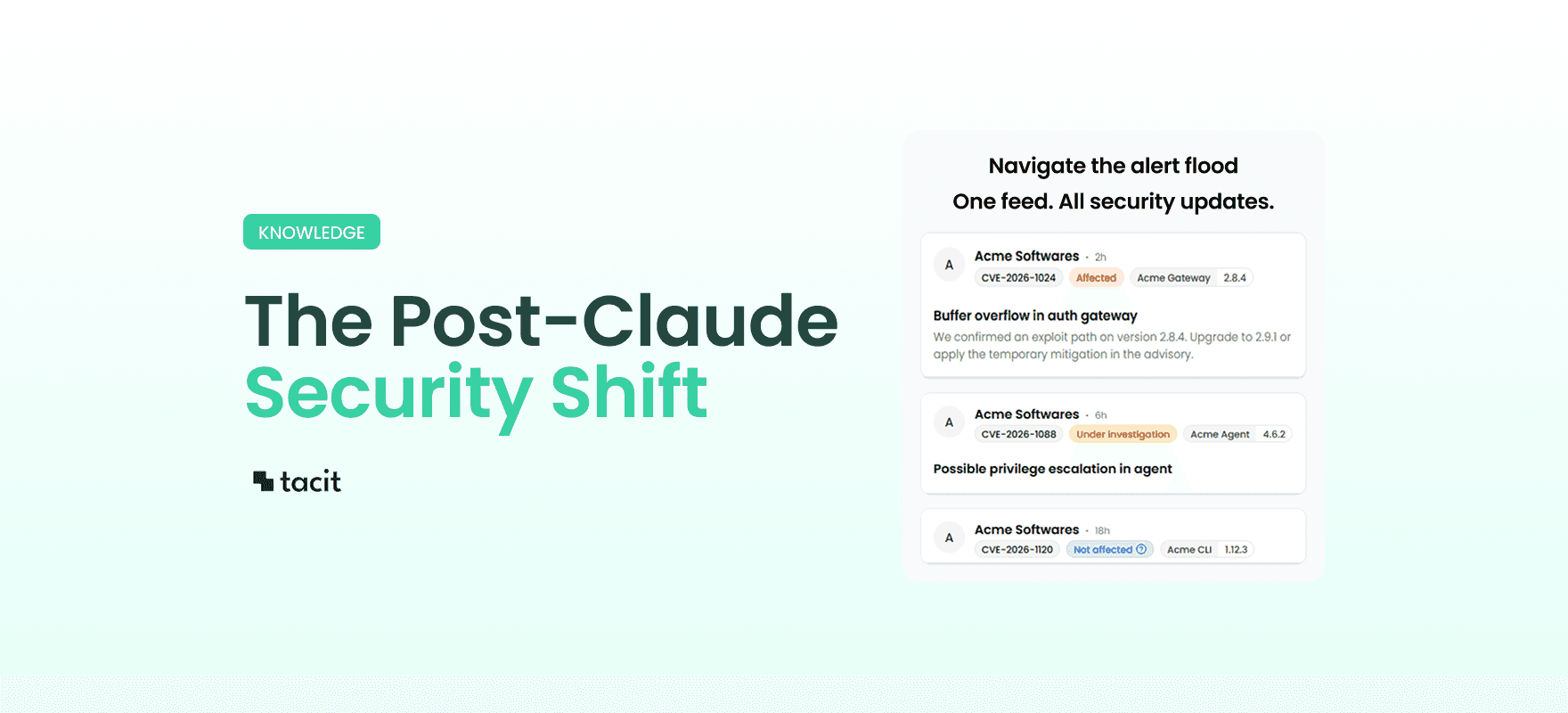
Tacit is emerging as the strategic layer for this transition. Rather than letting vendors drown in manual customer notification, it enables them to build advanced security status pages following the industry standard (OpenVEX).
Self-Service Clarity: These platforms allow vendors to publish "not applicable" statements once and for all. If a specific library triggers the scan alert but the vulnerable function is never called, the vendor can document this context publicly or via a secure portal.
By providing a machine-readable and human-auditable "Source of Truth," vendors can allow their customers to autonomously reconcile their scan results with the vendor's actual risk posture, stopping the "spam" before it starts.
Truth is the new moat
The "Claude shock" proved that finding vulnerabilities (or bugs) is becoming a commodity. In a world where every codebase is transparent to an AI, your security posture is only as good as your ability to explain it.
The winners of 2026 won't be the companies claiming to have "zero vulnerabilities", a claim AI has made obsolete, but the ones that build a culture of security transparency. By moving from reactive triage to proactive communication, vendors can turn a security burden into a competitive advantage, proving to their customers that they don't just find flaws, they master the risks.