Thoughts
Thoughts
Introducing Security Status Pages
Tacit is bringing the clarity of status pages to vulnerability disclosure.


Status pages have become standard.
When a service is degraded, customers know where to go. They check the page, understand what is happening, and wait for the next update instead of opening three tickets, emailing support, and asking their account team for answers.
Today, that same need applies to security and vulnerability communication.
As vulnerabilities become more visible, scans become more automated, and AI makes detection easier and cheaper, vulnerability disclosure is becoming a problem of its own. Not just for security teams, but for support, and customer-facing teams … for customers as well.
Security Status Page: the missing communication layer
Just as status pages gave companies a clear place to communicate about uptime, Security Status Pages give them a clear place to communicate when vulnerability questions start multiplying.
It helps teams:
reduce repetitive one-to-one responses across support, email, and account management;
give customers a shared source of truth during vulnerability investigations;
centralize the latest status, scope, and remediation guidance in one place;
make security updates easier to share internally and externally;
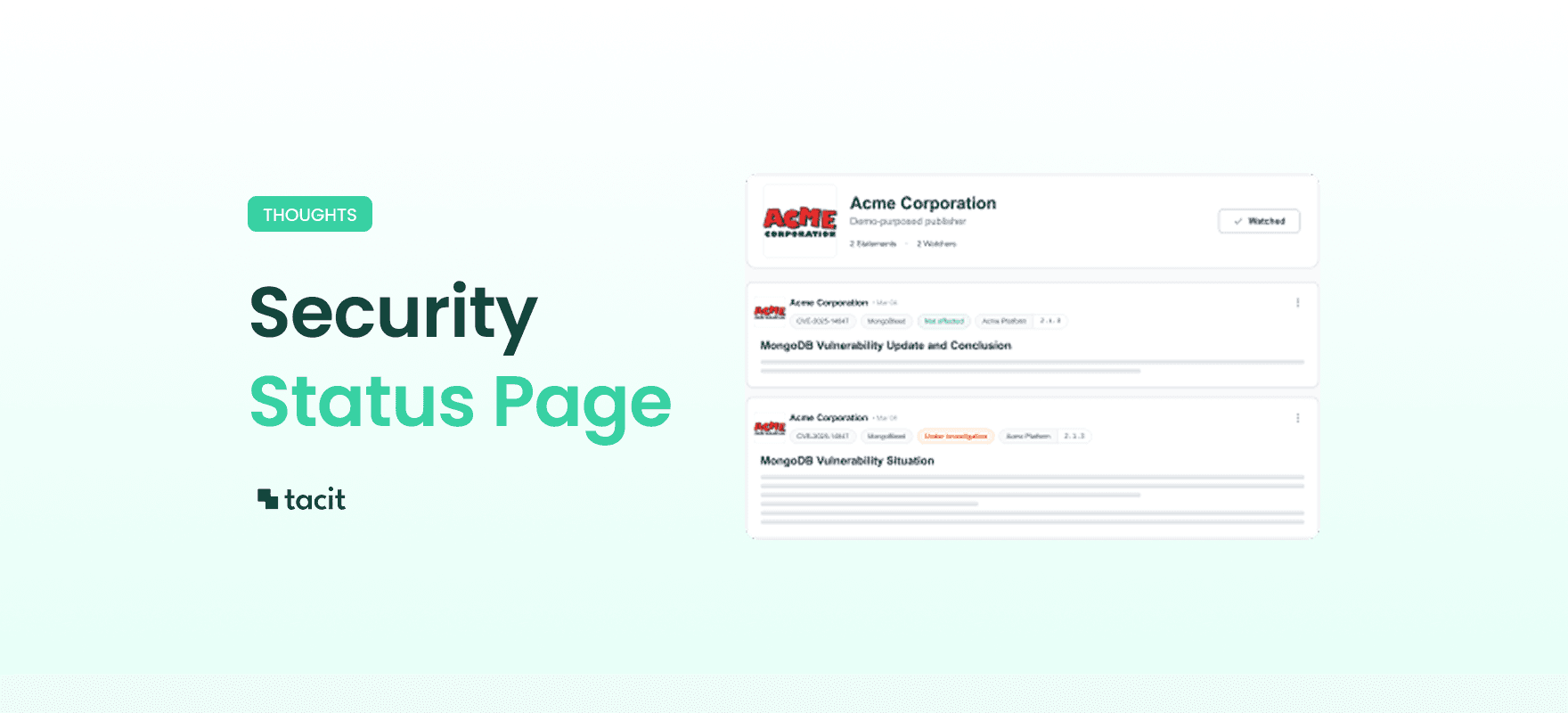
The Security Status Page hosts contextualized information about vulnerabilities in one place:
Status and scope: a clear statement on whether the publisher is affected, and if so, which products, versions, or components are involved.
Customer impact: guidance to help customers assess whether and how their own environment is affected.
Actionable remediation: documentation and resources to help customers mitigate the issue in the short term and fully remediate it over time.
Because security information can become a liability if released too early, a Security Status Page must support tiered visibility. Not every stakeholder should receive the same information, or receive it at the same time.
This aligns with Coordinated Vulnerability Disclosure (CVD) practices and the concept of embargo. The goal is to let a publisher share critical vulnerability details first with a trusted circle, giving those stakeholders time to patch and protect their systems before the information becomes public.
Signals that it’s time to launch one
You probably need a Security Status Page if vulnerability communication is already happening, just without structure.
That is often the case when:
you already have users or customers, and need a clearer, more auditable way to communicate vulnerabilities as Cyber Resilient Act CRA expectations rise;
support, security, or account teams keep repeating the same explanations across tickets, emails, and calls;
updates are spread across internal threads, one-off documents, and ad hoc replies;
high-visibility campaigns like Log4Shell, Shai-Hulud, or MongoBleed start circulating, and you want to position yourself before customers start reaching out one by one;
sales, procurement, or customer success teams need a clearer way to demonstrate security maturity during RFPs and due diligence.
On Tacit, each publisher manages its own page as a Security Status Page. It helps move vulnerability communication away from manual one-to-one disclosures and into a structured environment, where the right information is shared with the right audience at the right time.
Status pages have become standard.
When a service is degraded, customers know where to go. They check the page, understand what is happening, and wait for the next update instead of opening three tickets, emailing support, and asking their account team for answers.
Today, that same need applies to security and vulnerability communication.
As vulnerabilities become more visible, scans become more automated, and AI makes detection easier and cheaper, vulnerability disclosure is becoming a problem of its own. Not just for security teams, but for support, and customer-facing teams … for customers as well.
Security Status Page: the missing communication layer
Just as status pages gave companies a clear place to communicate about uptime, Security Status Pages give them a clear place to communicate when vulnerability questions start multiplying.
It helps teams:
reduce repetitive one-to-one responses across support, email, and account management;
give customers a shared source of truth during vulnerability investigations;
centralize the latest status, scope, and remediation guidance in one place;
make security updates easier to share internally and externally;
The Security Status Page hosts contextualized information about vulnerabilities in one place:
Status and scope: a clear statement on whether the publisher is affected, and if so, which products, versions, or components are involved.
Customer impact: guidance to help customers assess whether and how their own environment is affected.
Actionable remediation: documentation and resources to help customers mitigate the issue in the short term and fully remediate it over time.
Because security information can become a liability if released too early, a Security Status Page must support tiered visibility. Not every stakeholder should receive the same information, or receive it at the same time.
This aligns with Coordinated Vulnerability Disclosure (CVD) practices and the concept of embargo. The goal is to let a publisher share critical vulnerability details first with a trusted circle, giving those stakeholders time to patch and protect their systems before the information becomes public.
Signals that it’s time to launch one
You probably need a Security Status Page if vulnerability communication is already happening, just without structure.
That is often the case when:
you already have users or customers, and need a clearer, more auditable way to communicate vulnerabilities as Cyber Resilient Act CRA expectations rise;
support, security, or account teams keep repeating the same explanations across tickets, emails, and calls;
updates are spread across internal threads, one-off documents, and ad hoc replies;
high-visibility campaigns like Log4Shell, Shai-Hulud, or MongoBleed start circulating, and you want to position yourself before customers start reaching out one by one;
sales, procurement, or customer success teams need a clearer way to demonstrate security maturity during RFPs and due diligence.
On Tacit, each publisher manages its own page as a Security Status Page. It helps move vulnerability communication away from manual one-to-one disclosures and into a structured environment, where the right information is shared with the right audience at the right time.